-
- Tổng tiền thanh toán:
Aromatherapy for Everyday Wellness—not Medical Treatment
Tác giả: Admin Ngày đăng: 12.09.2026
Aromatherapy for Everyday Wellness—not Medical Treatment
Aromatherapy can be a meaningful part of everyday wellness when its role is described accurately. A pleasant scent may help make a room feel calmer, mark the transition from work to rest, make massage or body care more enjoyable, or create a familiar ritual while travelling. Essential oils, however, should not be presented as products that diagnose, prevent or treat disease. The U.S. National Center for Complementary and Integrative Health describes aromatherapy as the use of plant essential oils as a complementary health approach, while also emphasizing that evidence varies greatly by condition and use.

The distinction is simple but important:
Aromatherapy can be part of how you care for your everyday experience. It should not replace healthcare when healthcare is needed.
What We Mean by Everyday Wellness
“Wellness” is a broad word, so it helps to define what we actually mean.
At Aroma Vietnam, everyday wellness refers to practical things such as:
creating a pleasant home or hotel environment;
developing a wind-down routine after a busy day;
enjoying scent during a shower or body-care ritual;
taking several quiet minutes for gentle self-massage;
making an unfamiliar travel space feel more personal;
choosing a fragrance associated with work, rest or a particular memory;
caring for the body after a long journey or beach day;
creating small routines that are pleasant enough to repeat.
These are ordinary human experiences.
They do not require a medical claim to be worthwhile.
A quiet room can feel better than a noisy one.
A warm shower can mark the end of a long travel day.
A fragrance you genuinely enjoy can make that moment more memorable.
A body oil can make gentle self-massage more comfortable.
Those benefits are understandable without saying that the product has treated a disease.
This distinction is a central principle of Aroma Vietnam's everyday-wellness content framework.

Where Aromatherapy Fits
Aromatherapy fits most naturally where scent, context and ritual meet.
Creating atmosphere
A fragrance can change the perceived character of a room.
Fresh citrus or Vietnamese lemongrass may make a daytime space feel brighter.
Lavender, softer florals or woody notes may suit a quieter evening atmosphere.
This does not mean every person reacts identically.
Scent preference is highly individual.
For a deeper explanation, see [Scent and Relaxation: What Aromatherapy Can and Cannot Do → https://aroma-vn.vn/blogs/news/aromatherapy-and-relaxation-benefits-limits-safety].
Marking transitions
Modern days often contain few natural boundaries.
Work messages continue into dinner.
Travel planning continues in bed.
The phone remains active until the moment the lights go off.
Scent can become one cue in a transition ritual:
finish work → shower → softer light → familiar aroma → quieter activity
The fragrance does not need to biologically “switch on” relaxation.
Its role can simply be to belong to a repeatable context.
Making body care more enjoyable
A body or massage oil can combine several experiences:
touch;
moisturising;
fragrance;
slower movement;
time away from a screen.
If someone feels more relaxed afterwards, it may be difficult—and often unnecessary—to attribute the experience to only one component.
Massage, scent, expectation, touch and environment may all contribute.
NCCIH notes that massage is used both to enhance wellness and in some health contexts, while evidence varies depending on the condition studied.
Supporting travel routines
Travel disrupts familiar sensory cues.
A hotel has different bedding, air-conditioning, light, noise and cleaning fragrances.
A personally chosen scent can provide a small element of continuity.
That is why aromatherapy can fit naturally into travel wellness without becoming a jet-lag treatment.
See [How to Create a Calming Hotel Room After a Long Flight → https://aroma-vn.vn/blogs/news/how-to-create-a-calming-hotel-room-after-a-long-flight].
Where Aromatherapy Does Not Fit
Responsible wellness education also requires knowing where scent should stop.
Aromatherapy should not be used to:
diagnose the reason for persistent symptoms;
replace prescribed medication;
replace psychotherapy;
delay medical evaluation;
manage a medical emergency;
promise treatment for insomnia;
claim to treat anxiety disorders;
claim to heal an injury;
claim to remove toxins;
claim to cure inflammation or disease;
guarantee hormonal, immune or neurological effects.
This is not an argument against aromatherapy.
It is an argument for using the right tool for the right purpose.
You can enjoy lavender before bed and still speak with a doctor about persistent sleep problems.
You can use massage oil after a flight and still seek medical advice for unexplained one-sided swelling.
You can enjoy a bright citrus aroma at your desk without claiming that it reliably improves intelligence or brain performance.
Everyday wellness and medical care can coexist.
They do not need to compete.
Complementary Does Not Mean Replacement
The word complementary is useful.
It suggests that a wellness practice can exist alongside conventional healthcare rather than trying to replace it.
NCCIH describes aromatherapy as a complementary health approach and notes that essential oils are most often inhaled or applied to the skin in diluted form.
This is different from telling someone:
“Use essential oil instead of your treatment.”
That is not the responsible role of a wellness brand.
Aroma Vietnam's approach is therefore to discuss essential oils where scent and everyday experience are relevant, while keeping diagnosis and treatment within the appropriate healthcare setting.
Why Product Language Matters
Words shape expectations.
Consider the difference between these statements.
“A soft lavender aroma for your evening wind-down.”
and:
“Lavender treats insomnia.”
The first describes intended use and sensory context.
The second makes a medical treatment claim.
Or:
“A fresh herbal blend for an active-feeling workspace.”
versus:
“This oil improves brain function and concentration.”
Again, the second statement asks the product to prove much more.
This is not merely a matter of cautious writing.
Product claims have real meaning. The U.S. FDA explains that if aromatherapy products are marketed with claims that they treat or prevent disease, or affect the structure or function of the body, those claims can place them in the drug category under U.S. law. Examples include claims that a product treats depression or anxiety, relieves pain or helps a person sleep.
For consumers, the practical lesson is even simpler:
Specific, modest language is usually more trustworthy than a long list of dramatic health promises.
Why Aroma Avoids Turning Every Scent Into a Treatment
Aromatherapy products can have value without exaggerated claims.
Lavender can smell beautiful.
Jasmine can create a rich floral body-care ritual.
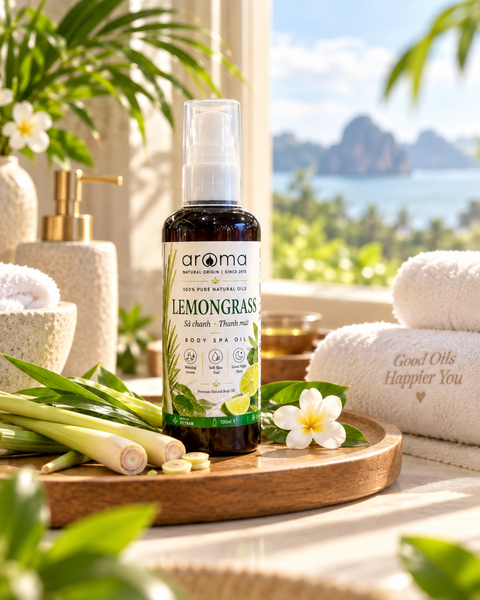
Vietnamese lemongrass can make a room feel fresh and become part of someone's memory of travelling in Vietnam.
A warming aromatic body oil can make massage feel pleasant.
None of these experiences become less meaningful because we do not call them treatments.
Aroma Vietnam has worked with natural-origin scent since 2010.
That history tells you how long the brand has been connected with fragrance and body-wellness products.
It does not make Aroma a medical provider, and it is not proof that a product treats disease.
That boundary strengthens rather than weakens the brand.
It allows consumers to know what they are actually buying.
Essential Oil, Body Oil and Fragrance Are Not the Same Thing
One of the most important forms of consumer education is product-category clarity.
A product that smells like lavender is not automatically lavender essential oil.
A body oil containing essential oils is not the same as a bottle of pure essential oil.
A reed diffuser should not be used as a body product.
These categories have different purposes.
Pure Essential Oil
A pure essential oil is a concentrated aromatic botanical extract.
It is normally used in appropriate aromatic applications or diluted when topical use is suitable according to product instructions.
“Pure” does not mean:
safe to swallow;
suitable for the eyes;
appropriate undiluted on all skin;
suitable for every child or adult;
medically therapeutic.
Essential oils remain concentrated substances.
Essential Oil Blend
An essential oil blend combines two or more essential oils.
A blend might be named:
Calm;
Focus;
Energy;
Citrus;
Breath.
These names should be interpreted as descriptions of the intended scent experience.
For example, a “Focus” blend may have a fresh herbal or citrus profile selected for an active environment.
It does not guarantee improved cognitive performance.
Read [How to Choose a Scent for Focus, Relaxation or Energy → https://aroma-vn.vn/blogs/news/how-to-choose-a-scent-for-focus-relaxation-or-energy] for a fuller explanation.
Body or Massage Oil
A body or massage oil is a topical oil-based product formulated for the body according to its label.
It normally contains carrier oils and may include aromatic ingredients.
It can provide:
glide for gentle massage;
skin softness;
aroma;
a more enjoyable body-care ritual.
It should not automatically be described as treating muscle injury, edema or circulatory disease.

Roll-On
A roll-on is a portable topical aromatic format.
Depending on the formulation, it may already be diluted for skin use.
Its purpose is different from both a pure essential oil and a full-body massage oil.
Diffuser and Home Fragrance
Diffusers and home-fragrance products are primarily intended to change the scent of the surrounding environment.
A reed diffuser belongs in the room.
A body oil belongs on the body according to its label.
This sounds obvious, but clear categorization is one of the most useful things a wellness retailer can offer.
For more detail, see [Pure Essential Oil vs Fragrance Oil vs Body Oil → https://aroma-vn.vn/blogs/news/pure-essential-oil-vs-fragrance-oil-vs-body-oil.
“Natural” Does Not Mean Suitable for Every Use
Plant origin is not a universal safety guarantee.
The FDA specifically notes that an aromatherapy product being “natural” or “organic” does not automatically make it safe.
Essential oils may cause skin irritation or allergic reactions in some users.
Specific oils can have additional considerations.
For example, NCCIH notes that topical lavender products may cause allergic skin reactions and that lavender aromatherapy can sometimes cause headache or coughing.
A sensible essential-oil routine therefore includes:
following product directions;
appropriate dilution where relevant;
avoiding the eyes and mucous membranes;
not swallowing oils unless a product is specifically intended and professionally guided for that route;
paying attention to skin reactions;
using reasonable ventilation;
considering children and pets;
seeking appropriate guidance during pregnancy or when medical conditions or medications create uncertainty.
For practical safety information, continue to [Essential Oil Safety Guide → https://aroma-vn.vn/blogs/news/how-to-use-pure-essential-oils-safely.
What About Research That Shows Benefits?
Research on aromatherapy should neither be exaggerated nor ignored.
Some studies have reported promising findings for certain populations and outcomes.
For example, reviews of aromatherapy and sleep have reported potential improvements, while researchers still call for larger and more rigorous studies.
Lavender research illustrates another problem.
Some studies investigate inhalation.
Others investigate massage with lavender oil.
Still others study standardized lavender products taken orally.
Those are different interventions.
NCCIH notes that while some lavender research has produced encouraging results, study quality and methodology often limit the conclusions that can be drawn; in massage studies, it can also be unclear how much of the effect comes from lavender versus massage itself.
Responsible evidence communication therefore asks:
What exact product was studied?
How was it used?
Who participated?
What outcome was measured?
That is more useful than simply saying:
“Science proves lavender works.”
Everyday Wellness for Travelers in Da Nang
For international visitors, everyday wellness often begins with very ordinary needs.
After a long flight:
shower;
move gently;
drink according to thirst;
make the hotel room comfortable;
reduce excessive stimulation.
After My Khe Beach:
rinse away salt and sand;
inspect the skin;
moisturize appropriately;
avoid aggressive fragrance on irritated or sunburned skin.
After hours carrying luggage:
resume gentle movement;
use comfortable self-massage if appropriate;
recognize when pain is unusual.
At night:
lower the lights;
reduce unnecessary screens;
choose one gentle scent if you enjoy it;
let the room become quieter.
These routines are part of travel wellness precisely because they remain practical.
Aroma does not need to promise that a visitor will “recover faster” medically.
Sometimes the useful outcome is simply:
“I feel more comfortable in my room tonight.”
Vietnamese Scent Can Also Be Cultural Experience
Wellness is not the only reason people buy fragrance while travelling.
A scent can become a souvenir of place.
Vietnamese lemongrass may later bring back memories of:
tropical gardens;
My Khe Beach;
Vietnamese massage and spa culture;
hotels and resorts;
cooking;
a particular trip.
Jasmine can carry another type of memory.
Lavender or citrus may become connected with an evening routine during the journey.
This is one reason natural fragrance can make a thoughtful Vietnam gift.
Its value does not need to rest on a medical promise.
A scent can be meaningful because it reminds you of somewhere.
When Professional Medical Care Comes First
The most responsible wellness advice sometimes ends with:
Do not use a wellness product for this.
Seek appropriate professional care when symptoms are persistent, severe, unexplained or concerning.
Examples include:
significant or worsening pain;
unexplained weakness or numbness;
breathing difficulty;
chest pain;
fainting;
substantial injury;
significant allergic reactions;
persistent sleep problems affecting daytime function;
concerning mental-health symptoms;
other symptoms that feel beyond ordinary self-care.
Massage should not be used to postpone medical evaluation of a medical problem; NCCIH makes this principle explicit in its consumer guidance.
Likewise, aromatherapy should not become a reason to delay care.
For the specific boundary around persistent sleep problems, read [When Sleep Problems Need a Doctor, Not an Essential Oil → https://aroma-vn.vn/blogs/news/when-sleep-problems-need-a-doctor-not-an-essential-oil].
A More Useful Way to Think About Aromatherapy
Instead of asking:
“What can this essential oil treat?”
try asking:
“Where does this scent fit safely and realistically in my life?”
Maybe the answer is:
in a diffuser while reading;
in a hotel room after a long flight;
as a roll-on during travel;
in a body oil after a shower;
as part of a quiet evening ritual;
simply as a fragrance you love.
That question creates space for aromatherapy to be useful without forcing it to become medicine.
Frequently Asked Questions
Is aromatherapy a medical treatment?
Aromatherapy is commonly used as a complementary wellness approach, but ordinary consumer aromatherapy should not be assumed to diagnose or treat medical conditions. Essential oils may be used for scent, relaxation rituals and other everyday experiences while medical problems remain the responsibility of appropriate healthcare professionals.
Does aromatherapy really work?
It depends on what “work” means. Aromatherapy may help some people create a pleasant environment, enjoy a relaxation routine or feel more comfortable during certain experiences. Evidence for specific medical outcomes varies considerably, so broad claims that aromatherapy “works for everything” are not supported.
Can essential oils treat anxiety?
Some essential-oil preparations, especially lavender, have been researched in relation to anxiety, but results vary by preparation, route and study quality. A consumer aroma product should not automatically be promoted as treatment for an anxiety disorder.
Can essential oils help with sleep?
A pleasant scent may be part of an evening wind-down routine, and some aromatherapy research has reported improvements in sleep-related outcomes. However, larger and stronger studies are still needed for many claims. Persistent sleep problems should not be self-treated with essential oils alone.
Are natural essential oils always safe?
No. Natural origin does not guarantee universal safety. Essential oils are concentrated substances and may cause irritation or allergic reactions. Safety depends on the specific oil, concentration, route of use and individual user.
Is body oil the same as essential oil?
No. A body or massage oil is a topical formulation designed for use on the body according to its directions. Pure essential oil is a concentrated aromatic plant extract. The two products have different concentrations and intended uses.
Why does Aroma Vietnam avoid strong medical claims?
Because scent, body care and everyday wellness do not need medical promises to have value. Clear language helps consumers understand what a product realistically does and prevents relaxation, atmosphere or body-care experiences from being confused with diagnosis and treatment.
Can aromatherapy be part of travel wellness in Da Nang?
Yes. Travelers may use fragrance as part of hotel-room routines, post-flight wind-down, gentle massage or personal scent rituals. In Da Nang, botanical fragrances can also become part of the sensory memory of Vietnam. Aromatherapy should remain an addition to ordinary self-care rather than a substitute for needed healthcare.
Quick Wellness Guide in Your Language
Русский
Ароматерапия может быть частью повседневного wellness, но она не должна заменять медицинское лечение. Эфирные масла подходят для создания приятной атмосферы, вечернего ритуала, ароматизации комнаты или дополнения лёгкого массажа. Это не означает, что они диагностируют или лечат бессонницу, тревожные расстройства, травмы или другие заболевания.
Важно также различать продукты: чистое эфирное масло — концентрированный растительный экстракт; массажное масло уже предназначено для использования на теле согласно инструкции; ролл-он и аромат для помещения имеют другие задачи.
В Дананге ароматерапия может стать частью отдыха после перелёта, вечера в отеле или воспоминанием о Вьетнаме. Хороший wellness-продукт не обязан обещать лечение, чтобы быть полезным.
繁體中文
芳香療法可以成為日常 wellness 的一部分,但不應被當成醫療治療。喜歡的氣味可以讓飯店房間更舒服、成為睡前儀式的提示,也可以搭配適合身體使用的按摩油,讓自我照顧的過程更愉快。
純精油、按摩油、滾珠香氛與居家香氛並不是同一種產品。純精油屬於高濃度植物芳香萃取物,使用方式與已經調配好的身體油不同。
在峴港旅行時,香氣可以融入長途飛行後的休息、美溪海灘後的晚間 routine,或成為一份帶回家的越南氣味記憶。但精油不能診斷或治療失眠、焦慮症或其他疾病。真正負責任的芳香療法,是知道它能帶來什麼,也知道什麼時候應該尋求醫療專業協助。
日本語
アロマテラピーは、毎日のウェルネスや旅のセルフケアに取り入れることができます。好きな香りでホテルの部屋を心地よくしたり、夜の習慣の合図にしたり、マッサージオイルとともにゆっくり過ごしたりすることには十分な価値があります。
一方で、精油を不眠症や不安障害、けがなどの治療として考えるのは適切ではありません。
純粋な精油、ボディオイル、ロールオン、ルームフレグランスは用途が異なります。製品の種類と使用方法を確認することが大切です。
ダナンでは、香りを旅のセルフケアだけでなく、ベトナムを思い出す感覚的なお土産として楽しむこともできます。アロマの役割は治療ではなく、日常の時間や空間を心地よくすることです。
한국어
아로마테라피는 일상적인 웰니스와 여행 후 셀프케어의 한 부분이 될 수 있지만 의료 치료를 대신해서는 안 됩니다. 자신이 좋아하는 향은 호텔 방을 더 편안하게 만들거나, 저녁 루틴의 신호가 되거나, 마사지와 바디케어 시간을 즐겁게 하는 데 활용할 수 있습니다.
순수 에센셜 오일, 마사지 오일, 롤온, 공간 향 제품은 서로 다른 제품입니다. 특히 순수 에센셜 오일은 농축된 식물 향 추출물이므로 모든 상황에서 피부에 바로 사용하는 제품으로 생각해서는 안 됩니다.
다낭 여행 중에는 미케비치에서 돌아온 저녁, 장거리 비행 후 휴식 또는 베트남의 향을 기억하는 방법으로 아로마를 즐길 수 있습니다. 하지만 지속적인 수면 문제, 심한 통증이나 다른 건강 문제는 에센셜 오일이 아니라 적절한 의료 평가가 우선입니다.
Aromatherapy does not become less valuable when we stop asking it to cure something. Its everyday value can be simpler—and often more believable: a fragrance you enjoy, a room that feels more comfortable, a body-care ritual that makes you slow down, or a scent from Vietnam that brings a journey back years later.
To explore essential oils, body oils and Vietnamese scent experiences with clear guidance on what each product is actually designed to do, visit Aroma Vietnam – Level 3, Vincom Plaza Da Nang, or Aroma Baret – Baret Urban Zone, An Thuong near My Khe Beach.
